
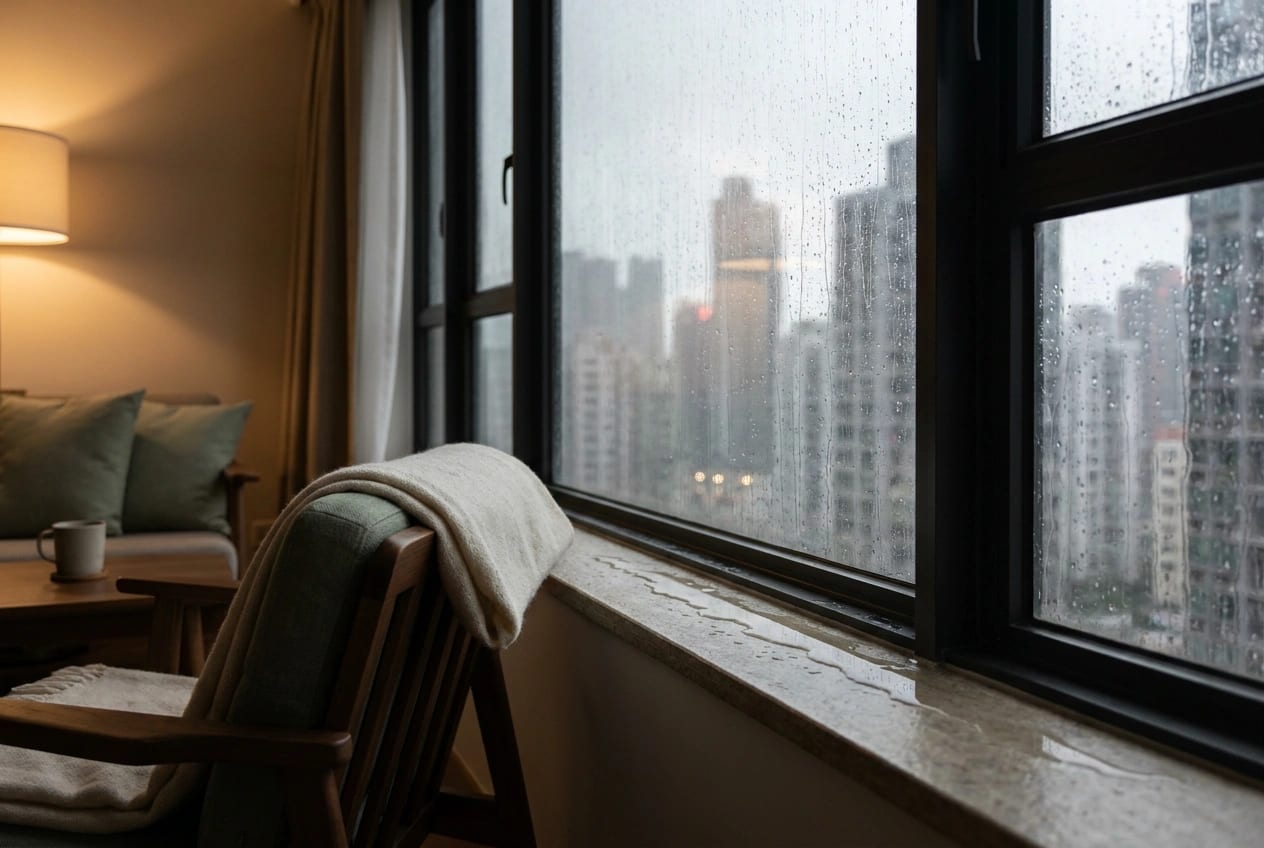
Water seepage is the most common defect in Hong Kong homes and the one most often handled the wrong way round. A stain spreads across a wall, the ceiling drips, the window sill holds water after a rainstorm, and the first instinct is either to skim and repaint, or to go straight upstairs and blame the neighbour. Both can waste the effort. Paint over a wall that is still wet and the same patch blisters again within months. Confront the flat above before the source is confirmed and you get a dispute rather than a repair. The Buildings Department groups flat seepage into four sources, and makes one point that governs everything else: water leaks and finds its path of least resistance through cracks and ducts, so the place the stain appears is often not the place the water comes from. That is why the first step is never repair. It is diagnosis. This article works through the four sources and how professionals tell them apart, the three tests an owner can run before calling anyone, the new Joint Office investigation procedure that took effect on 16 July 2026, and a boundary many owners discover only after weeks of waiting: seepage driven in by rain is generally not something the Joint Office will act on. It closes with the part that actually settles the problem, which is what happens during a renovation.
The four sources, and why the stain is not the source
The Buildings Department lists four common causes of seepage in a flat: leakage in drainage pipes, whether in the flat above, an adjacent flat or your own; leakage in water supply pipes; defective or deteriorated waterproofing of floor slabs or bath tub seals; and rainwater seeping in through the roof, podium, balcony, external wall or window.
Alongside that list the department states the principle that makes seepage so difficult to pin down: water finds its path of least resistance through cracks and ducts, which means the affected party, usually the flat below, is normally not the party who caused it, and the wet patch is often some distance from the breach. Chasing the stain is how owners end up opening the wrong ceiling.
The department also names the parts of a building most likely to seep if they were not carefully designed and supervised: roofs, external walls, curtain walls, windows, balconies, utility platforms, bathrooms, kitchens, plumbing and drainage pipes, car park floors and basements. In a Hong Kong flat the practical shortlist is short, which is what makes systematic elimination realistic rather than hopeless.
Reading the symptoms: where, when, and what it smells like
The Joint Office publishes a do-it-yourself pamphlet, and its first instruction is to observe and record four things: where the seepage is, whether it is continuous, intermittent or follows rain, how serious the dampness, odour and colour are, and whether any drainage pipe on the external wall is defective. Those four observations do most of the diagnostic work.
The pamphlet then gives the tell-tale signs for each source:
- A defective drainage pipe embedded in the slab above: the seepage sits below a kitchen, toilet or bathroom, appears intermittently in a roughly circular patch, and the area is mouldy with a foul smell.
- Defective waterproofing in the floor slab above: the seepage sits below a bathroom, a surface channel or a shower area, covers a relatively large area with even dampness, or appears near walls.
- A leaking water supply pipe in the slab: water actually drips at the seepage area, and a greyish crystalline deposit forms, which the pamphlet notes indicates the presence of salt water.
The Hong Kong Institute of Surveyors adds the pattern most owners can apply on their own: note whether the seepage is continuous or periodic, and whether it is associated with rainy days or with normal bathing. Seepage along an external wall is usually associated with rain or leaking external pipes, while dampness along internal walls may point to defective buried pipes, particularly hot water pipes that expand and contract more.
After a rainstorm: the seepage the Joint Office will not take up
This is the part that surprises owners, and it is stated plainly by the Food and Environmental Hygiene Department. Under normal circumstances, seepage originating from penetration of rainwater through roofs, flat roofs, balconies, external walls or windows of a building, or from leaking water pipes, will not cause any public health implication and is not nuisance actionable by the Joint Office under the Public Health and Municipal Services Ordinance (Cap. 132).
In other words, the classic typhoon-season complaint, water driven in around a window frame or through an external wall, falls outside the Joint Office's enforcement powers. This is triage rather than refusal. Where rainwater seepage through a rooftop or external wall raises a building safety risk such as concrete spalling or corrosion of reinforcement, or where rainwater or foul water pipes are defective, the case is referred to the Buildings Department under the Buildings Ordinance (Cap. 123), and referrals have been rising: 1,243 in 2022, 1,436 in 2023 and 2,200 in 2024.
So for rain-driven seepage the practical routes are the building's own management, through the owners' corporation and the Deed of Mutual Covenant where common parts are involved, or civil action, with a Buildings Department referral where safety is engaged. Knowing this early saves the weeks that would otherwise be spent waiting for an authority that was never going to act.
It also explains why the envelope matters so much. The institute lists the usual culprits at windows, which are exactly the ones a storm exposes: excessive gaps left at the concrete structure without proper filling, deformed frames and sashes, particularly aluminium, omitted water bars or weather flashing at window heads, defective or missing gaskets and mastic sealants, and improperly installed air conditioners. The Buildings Department is blunter still: an oversized window opening is one of the main causes of water seepage in windows.
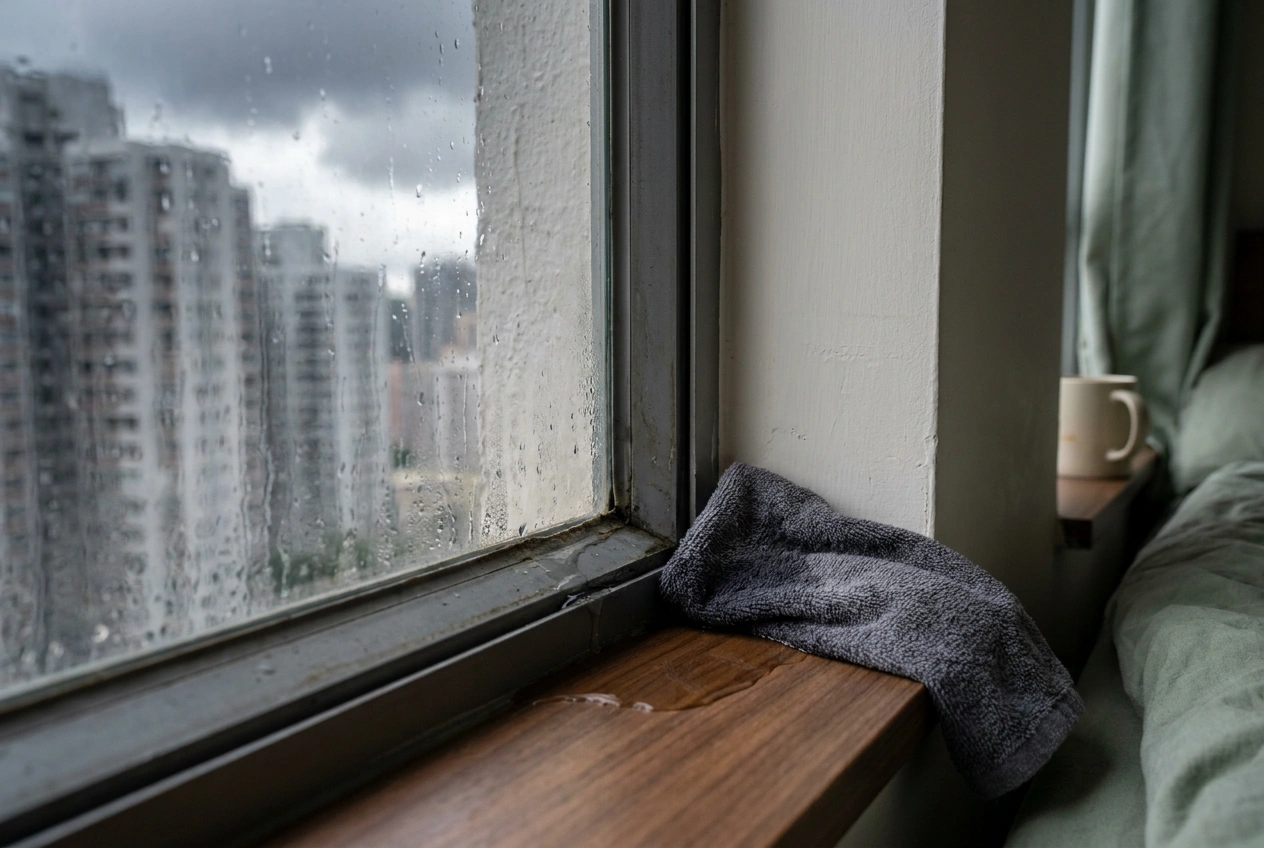
What changed on 16 July 2026
Announced on 17 June 2026 and applying to all cases received from 16 July 2026, the Joint Office rebuilt its investigation procedure, and most published descriptions of the process are now out of date.
- Infrared thermography at the first inspection. The initial stage now pairs infrared thermographic analysis with the electronic moisture meter that was previously used on its own.
- A notice in about 14 working days. Where the Joint Office has reason to believe the upper unit is the source, it issues a repair notice, 建議維修通知 in Chinese and a Notification Letter on the English site, within roughly 14 working days of the report. The government's own comparison is that this arrives about 57 working days earlier than under the previous flow.
- 28 calendar days to repair. The notice requires the owner to inspect and complete repairs within 28 calendar days.
- Concurrent testing. If seepage persists after that window, the second and third stages of investigation now run at the same time rather than one after the other.
- Cost recovery of not less than HK$17,000. The Joint Office now recovers inspection costs at that level from owners who failed to fulfil their responsibility.
Two clarifications matter. The notice itself carries no penalty of its own; enforcement still runs through the Cap. 132 nuisance notice and nuisance order route, where since 17 August 2025 non-compliance with a nuisance notice carries a maximum fine of HK$25,000 and non-compliance with a nuisance order a maximum of HK$50,000, with daily fines of HK$450 and HK$600 respectively. And the Joint Office has long declined to open an investigation where the moisture reading at the seepage location is below 35 per cent, a threshold that is administrative practice rather than statute and still appears on its website, though the 2026 announcements neither restate nor revise it.
Scale is worth knowing before you file. The Joint Office received 47,299 reports in 2024 and processed 46,907 cases, identifying the source in 5,080 of them while 4,874 ended with the source unfound and seepage persisting. The Ombudsman opened a direct investigation into the handling of seepage cases on 27 October 2025, which has not yet reported.
Who is responsible, and who pays
Responsibility is decided by the deed of mutual covenant far more often than by general rules, and this is where confident internet advice goes wrong most often.
Under the Building Management Ordinance (Cap. 344), an owners' corporation must maintain the common parts in a state of good and serviceable repair and clean condition, and must do what is reasonably necessary to enforce the deed's obligations. The ordinance defines common parts as the whole of the building except the parts specified in a registered instrument as being for an owner's exclusive use, and otherwise the parts listed in its first schedule, which includes external walls and load-bearing walls, foundations, columns and beams; roofs, gutters and chimneys; and water tanks, pumps, sewers, drains, soil pipes, waste pipes, channels, ducts, downpipes and conduits.
Because a registered instrument overrides that schedule, whether a particular slab or pipe is a common part is specific to your building. The structural slab between two flats is the most deed-dependent element of all and is very often a common part, so it should never be assumed to be the upstairs owner's private responsibility. Read the deed before allocating blame.
If the responsible party will not act, the Small Claims Tribunal hears monetary claims not exceeding HK$75,000, including claims for damage to property, and no legal representation is allowed. A claim above that limit cannot be split to fit, though a claimant may abandon the excess to bring it there; above HK$75,000 and up to HK$3 million the District Court has jurisdiction. A copy of the Joint Office's investigation report can be requested under the Code on Access to Information through the case officer, which is useful supporting material, though no government source describes it as decisive. Since July 2025 a community mediation pilot scheme has trained property management practitioners to help resolve inter-flat seepage disputes without litigation, on a voluntary basis.
Insurance: sudden is covered, gradual usually is not
The single most important insurance point for seepage is the distinction between an event and a condition. Sudden and accidental water damage, a burst pipe, an upstairs leak, rainwater entering during a typhoon, is generally claimable under home contents cover, and the personal liability section can respond where your flat's leak damages the unit below. Gradual seepage attributed to pipe ageing, poor maintenance or deteriorated waterproofing is treated as wear and tear and excluded. The seepage that has been quietly spreading for a year is precisely the seepage a policy is least likely to pay for.
Two further exclusions recur across the market: cover lapses where a property has been left vacant for 30 or more consecutive days, and policyholder negligence such as leaving windows open in a storm. In a 2018 study of 22 home insurance schemes from 13 insurers, the Consumer Council found that contents cover commonly included loss or damage from water flooding, burst water pipes and rainwater seepage, that 20 of the schemes included third party legal liability cover with widely varying limits, and that 10 of them set 40 years as the upper limit for building age. Those figures are from April 2018 and the pattern, not the numbers, is what still holds. Older stock, where seepage is most common, often needs individual underwriting. Read your own policy rather than any summary of the market.
Why repainting does not hold
Owners repaint because the stain is the visible problem. The mechanism explains why it returns. Where water reaches cement or concrete it combines with calcium and carries soluble salts to the surface, where evaporation leaves white crystalline deposits, an effect surveyors call efflorescence. Those crystals physically lift the paint film, which is why the blistering recurs in the same patch. Unless the wall is confirmed leak-free first, the repair simply restarts the clock.
The correct order is unglamorous: confirm the leak is stopped, scrape back to sound substrate, apply a damp-proof primer or sealer, skim until smooth, then repaint. Painting is a finish applied over a sound dry substrate. It is not, and has never been, a waterproofing measure. The Buildings Department's own advice is source-first: owners should directly engage a building technician or licensed plumber to identify the cause of seepage for prompt repairs.
Renovation is when seepage actually gets settled
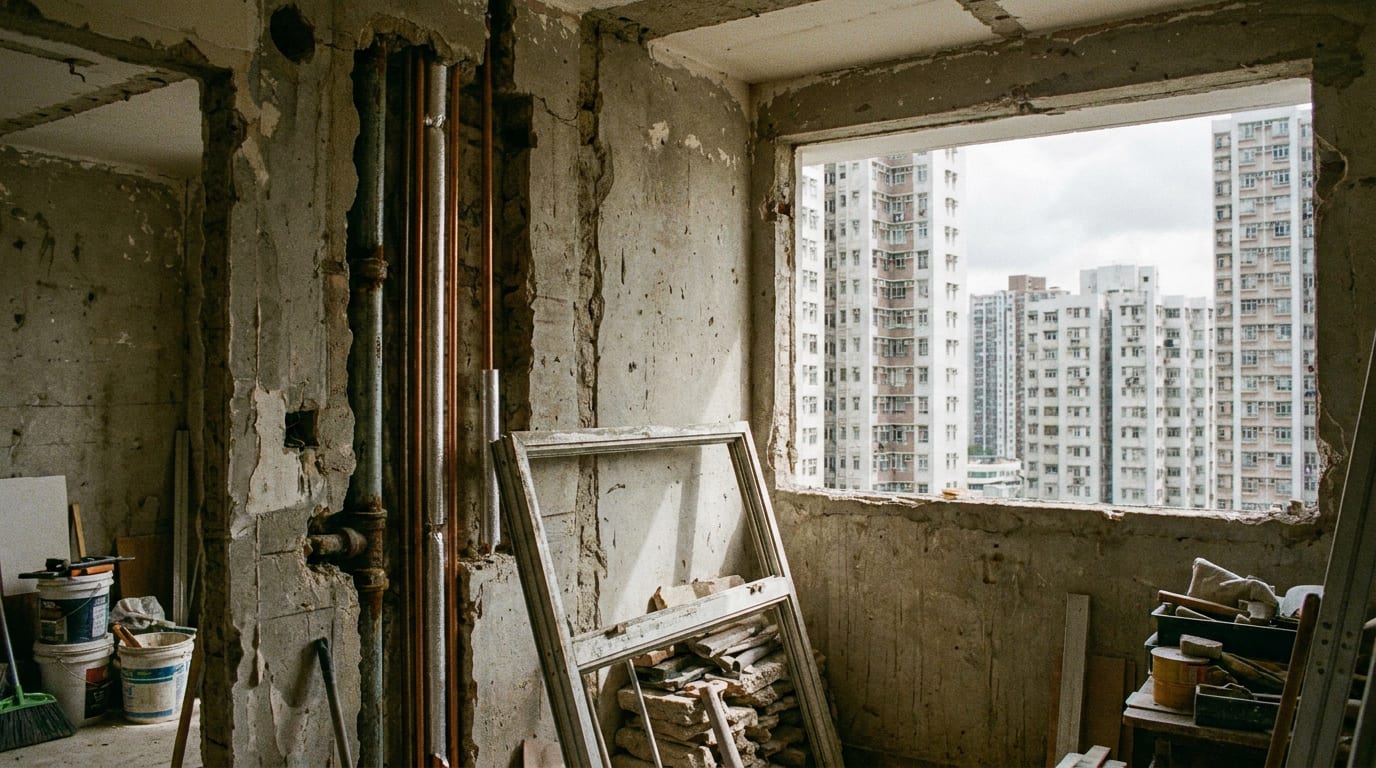
There is an uncomfortable fact in the Buildings Department's guidance that deserves to be quoted directly: in carrying out decorative works, care should be taken to avoid damaging the original waterproofing system. The Hong Kong Institute of Surveyors makes the same point about fitting-out works, listing the installation of fixtures, sockets and conduits among the things that damage the tanking. Renovation is one of the ways flats start to leak. It is also the only moment when the walls and floors are open enough to fix seepage at the source rather than over it.
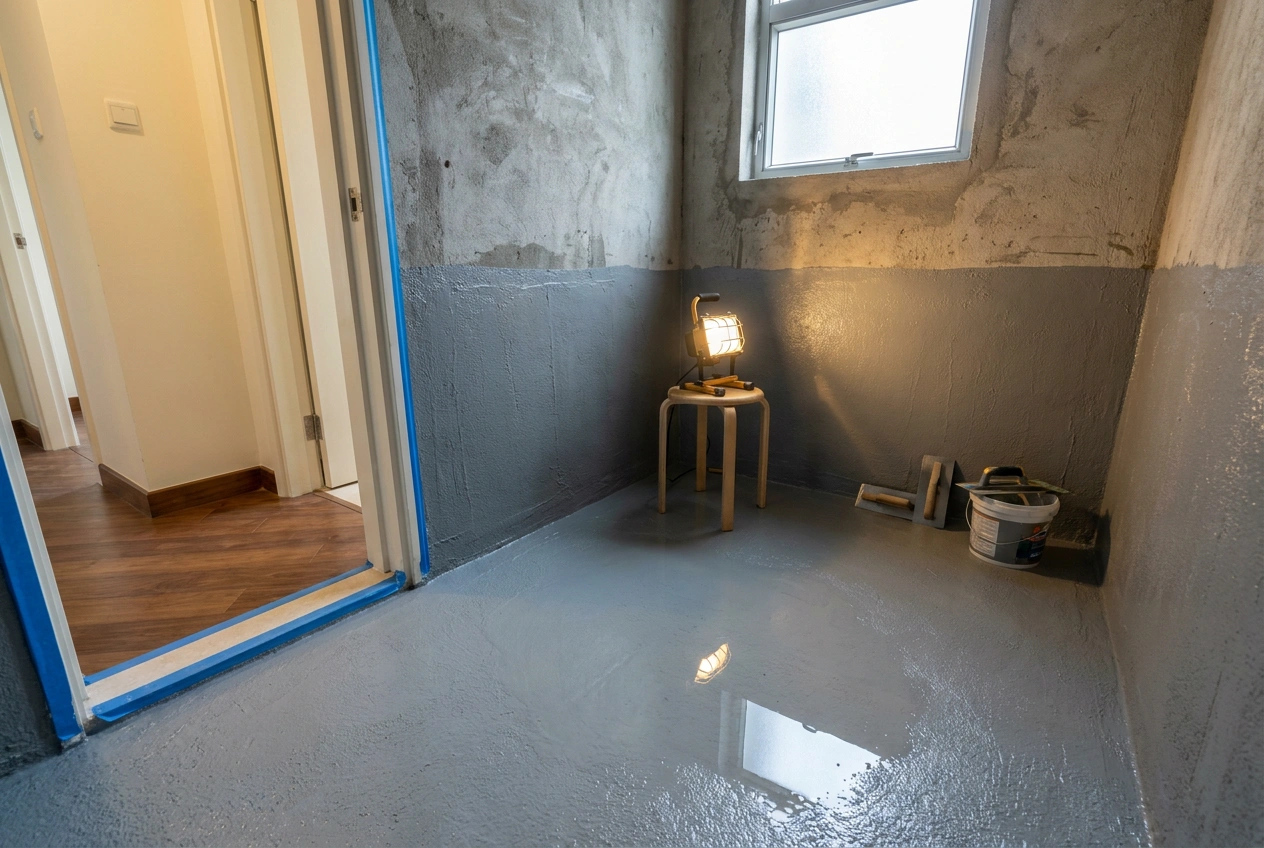
What that means in practice is a sequence rather than a product: prepare the substrate, reinforce the corners and angle fillets where movement concentrates, build the membrane up in coats, then hold a ponding test before anything is tiled over it. Hong Kong practice puts that test somewhere between 8 and 48 hours depending on the firm, with 24 hours as the professional benchmark used in investigation work. Concealed supply pipes are pressure tested at one and a half times the maximum supply pressure for at least an hour, after installation but before they are sealed into cement, because the cost of finding out later is measured in demolished finishes.
It is worth being straight about the standards. Nothing in Hong Kong law prescribes a membrane type, a thickness, a wall height or a test duration for renovating an existing private flat. The statutory requirements are performance-based: materials suitable for their purpose, external walls of impervious materials, walls in contact with damp adequately protected, floors of rooms with a water supply constructed to prevent penetration, roofs weatherproof. The specific numbers people quote, a membrane turned up at least 300mm at every wall, 2,200mm around baths and showers, 1,100mm behind a basin or sink, come from the Buildings Department's guidance for new buildings whose plans were submitted after 31 March 2025. They are not a legal requirement for your flat. Hong Kong renovation practice typically waterproofs a shower zone to about 1.8 metres, which is below that benchmark. There is nothing stopping a studio from adopting the higher figure as its own standard, and we think a bathroom is the wrong place to work to the minimum.
Nor are waterproofing contractors licensed here. A call for a statutory registration regime was not accepted, and what exists is a voluntary specialist register maintained by the Construction Industry Council. That places the burden on whoever is coordinating the work: to sequence the wet trades correctly, to test before covering up, and to still be answerable when a defect appears a year later. It is the main reason we run whole-home projects as design and build, with survey, drawings, wet trades and site supervision inside one programme and one accountable team, and a warranty that means something because the same team stands behind it.
If your flat is showing damp and a renovation is somewhere on the horizon, the two problems are better solved together than separately. Send us the floor plan and a photo of the affected area, and we will tell you honestly whether it is a maintenance job, a case for the Joint Office or the management office, or something to fold into the renovation.
Open WeChat, Discover, Scan
Or save the QR and import it from your gallery.