Walk-in closet design in Hong Kong is a different problem from the one you see in Taiwan or mainland guides, because very few of us have a whole spare room to turn into a dressing area. Most families are working with a flat of three to six hundred square feet, so a walk-in has to be carved out of a bedroom end, a corridor or a bay-window nook. First, three terms that get muddled: a walk-in closet or dressing room is an enclosed space you step into, with an aisle and storage on two or three sides; a step-in wardrobe sits in between; a plain fitted wardrobe is simply a run of joinery against a wall. The honest first question is whether your flat can actually justify a walk-in at all. As an Artwill designer, I would rather run those numbers with you before we start.
Walk-in closet, dressing room, step-in wardrobe: what is the difference
These three terms are used loosely in Hong Kong, yet the floor area they demand is very different. A walk-in closet and a dressing room are essentially the same thing: a small room you step fully into, with an aisle down the middle and storage lining two or three sides. A step-in wardrobe is built deep enough that you can take half a step in once the doors are open, sitting between a wardrobe and a room. A plain fitted wardrobe is just a wall of joinery that you stand in front of to reach your clothes. The distinction matters, because only the first one asks you to give up floor area for an aisle. If your real goal is simply to store clothes neatly, a well-planned fitted wardrobe is often the better value, and I cover its doors, depths and internal fittings in a separate custom-wardrobe guide. Decide which one you actually want first, so you do not surrender a few precious square feet for the sake of a label.
Does a small flat qualify for a walk-in, and how to judge if it is worth it
A comfortable walk-in usually needs an aisle of about ninety to a hundred centimetres, and if you want hanging on both sides you add roughly sixty centimetres of hanging depth on each. In other words, a double-sided dressing room often needs a clear width of over two metres, which is a genuine luxury in a compact Hong Kong flat. So I tell clients something the trade rarely says out loud: your flat may not have room for a true walk-in, and that is not a failure, it is good sense. The test is simple. Look at those few square feet on their own. If turning them into a dressing room means the bedroom loses a desk or a dressing table, are you willing to make that trade? If not, build the same depth as a floor-to-ceiling fitted wardrobe instead; the storage capacity is barely different, and you keep the aisle. If yes, then we move on to finding the leanest place to put it.
Five places to find a walk-in in a compact Hong Kong flat
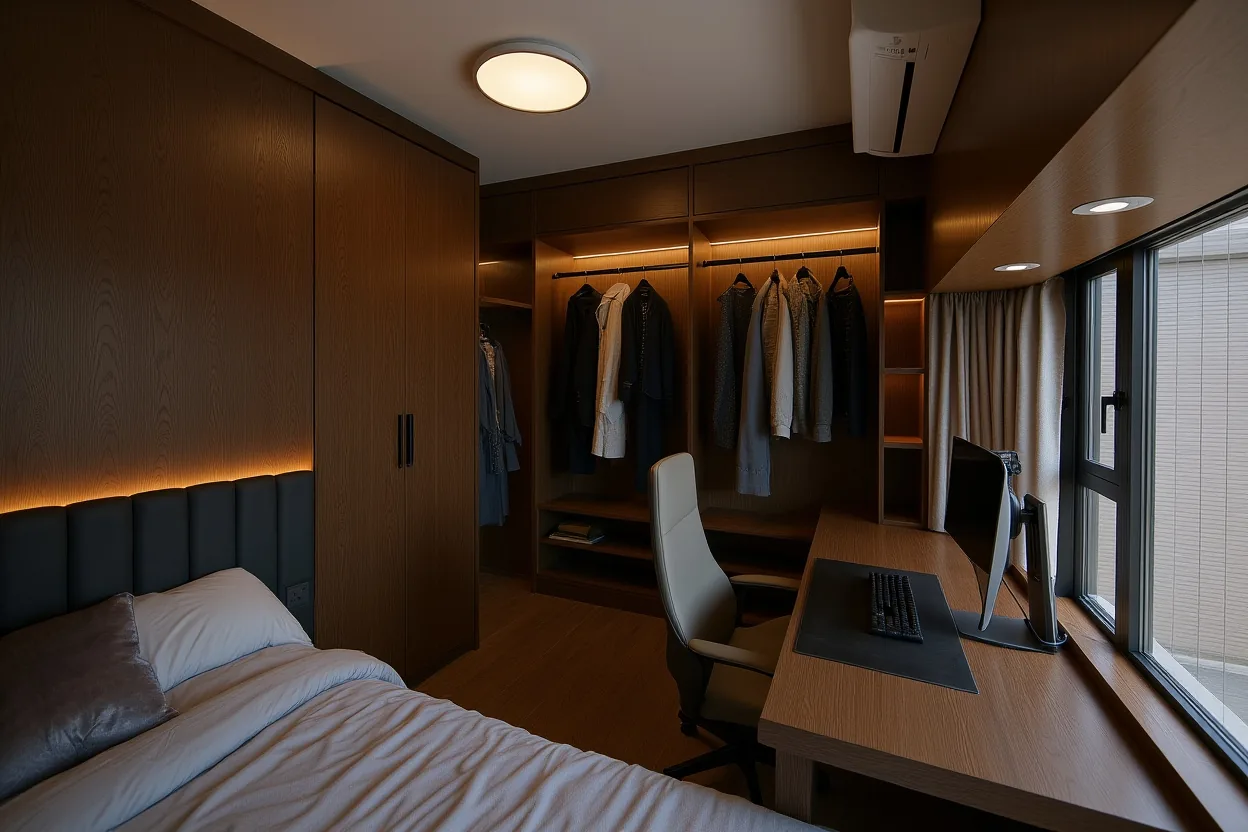
In real projects, dressing space rarely comes from an empty room. It is borrowed from the layout you already have. First, the end of the bed: if the main bedroom is deep enough, a low or full-height partition at the foot of the bed can hide a small dressing zone behind it. Second, a corridor: a passage that only ever gets walked through can gain shallow hanging and shelving on both sides, so you store as you pass. Third, a bay-window corner: extend the bay into a run of storage with hanging along the side, and daylight still reaches your clothes. Fourth, behind a partition: split sleeping and dressing with a joinery unit or a glass screen, and the dressing side becomes a semi-open corner of its own. Fifth, a corner of the main suite: if you already have an ensuite, the transition between bathroom and bedroom can become a single-line dressing corridor. Which one suits you depends on your flat's real dimensions and circulation, and that is the first thing I look at when I measure on site.
Single-line, L-shape, U-shape and open: which layout suits which space
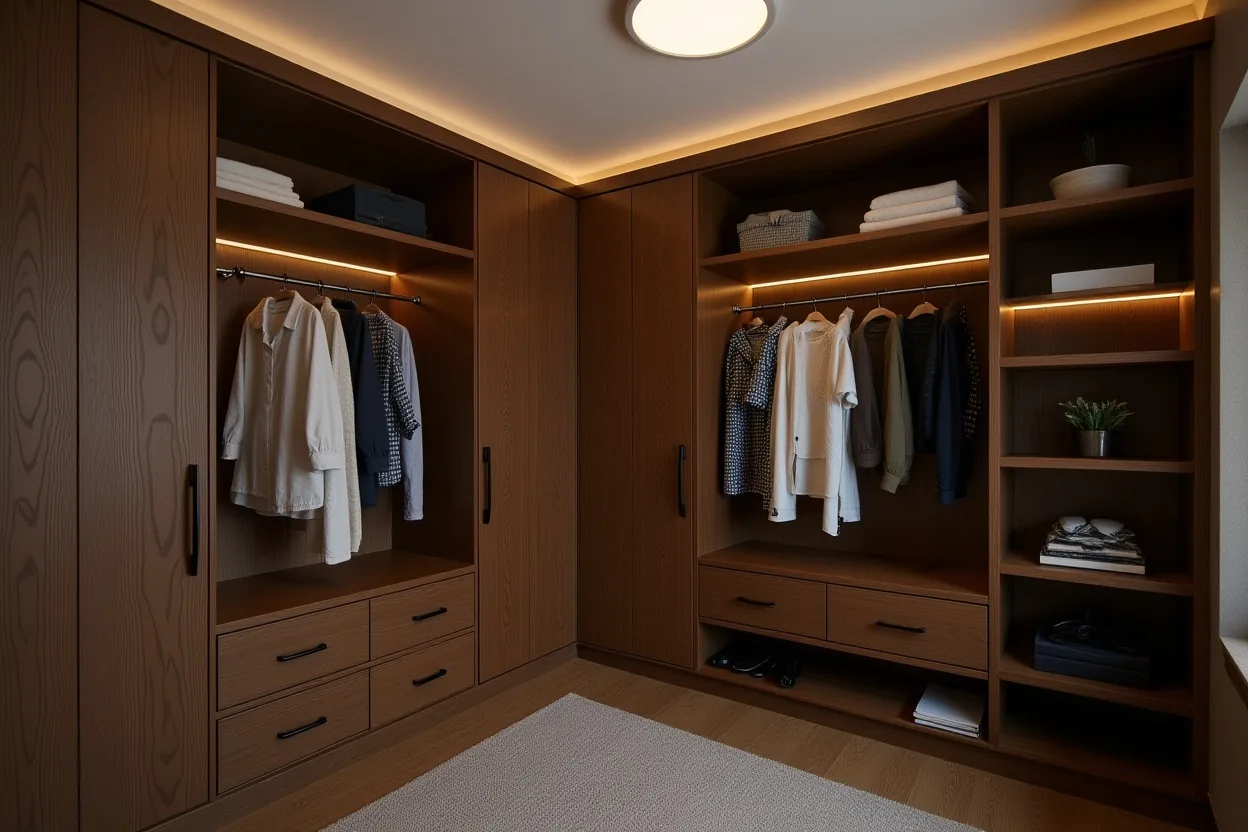
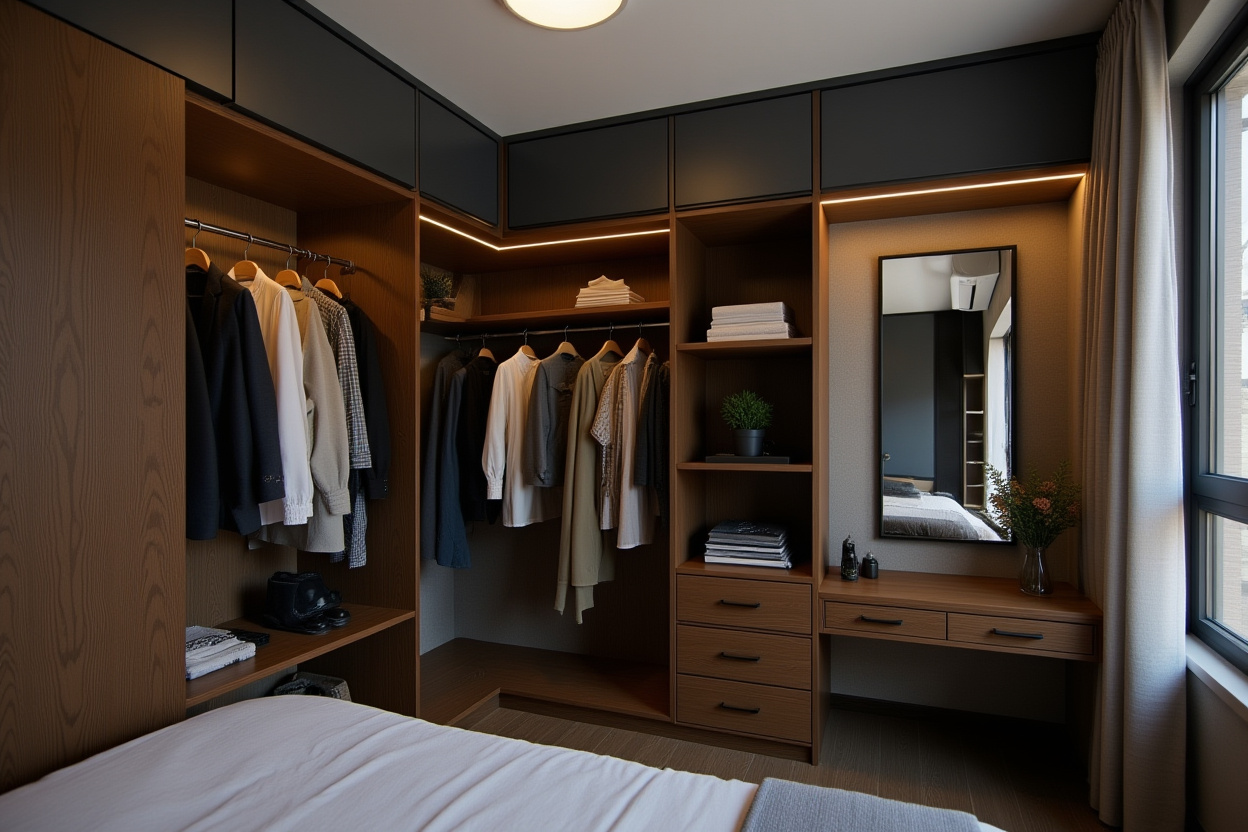
Once the place is set, choose the layout. A single-line run is the leanest, with all storage on one wall, ideal for the narrow strip of a corridor or a bed end where only one side is usable; you never truly step in, you reach from the front. An L-shape uses a corner and both adjacent walls, suited to a bedroom corner or a square area behind a partition, and it clearly increases capacity. A U-shape wraps three sides for the most storage, but it needs an almost self-contained, squarish space, which in Hong Kong usually only a larger main suite can offer. An open layout drops the doors, showing hanging and shelving on view: light and quick to use, but demanding on dust and tidiness. For small flats I usually start with a single-line or L-shape: get the circulation and aisle right first, then talk about looks. Choose the layout well and the same floor area holds around a third more clothing.
The numbers to remember: aisle, hanging depth, shelves and drawers
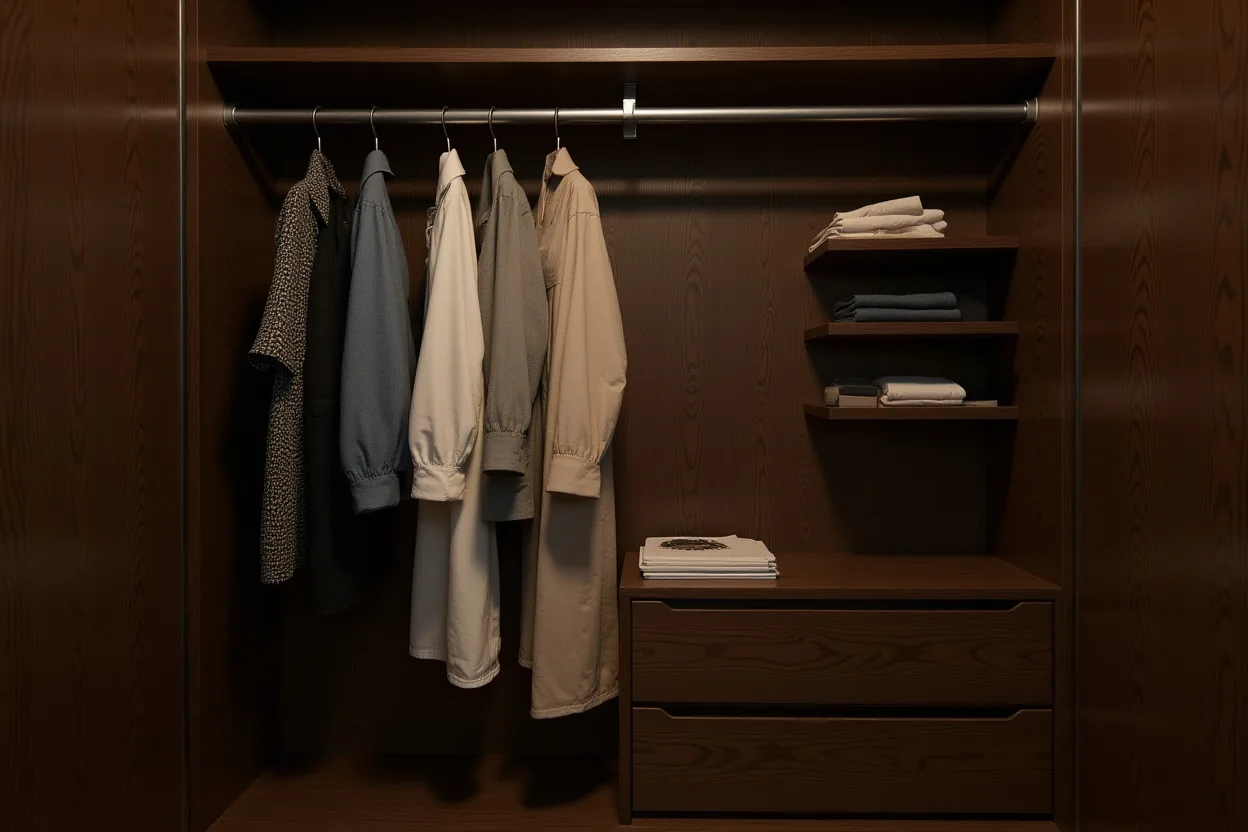
Whether a walk-in works often comes down to a handful of dimensions. The aisle: from about ninety centimetres for one person, and better at a hundred if you need to crouch to open drawers. Hanging depth: jackets and shirts need about fifty-five to sixty centimetres, while long coats want a hanging zone over roughly a hundred and forty centimetres in height. Between shelves, about thirty-five centimetres per bay is comfortable for folded clothes; drawers work best for underwear, socks and small items, in two useful heights of around twenty and thirty centimetres. Leave a spot for a full-length mirror, ideally facing the light. You do not need to memorise these yourself, but understanding the logic tells you why the same wall holds twice the clothing for one person and not another. Real planning starts by counting what you actually own, then working backwards to each compartment, not by drawing a handsome elevation first.
Hong Kong humidity and dust: ventilation, damp control and lighting
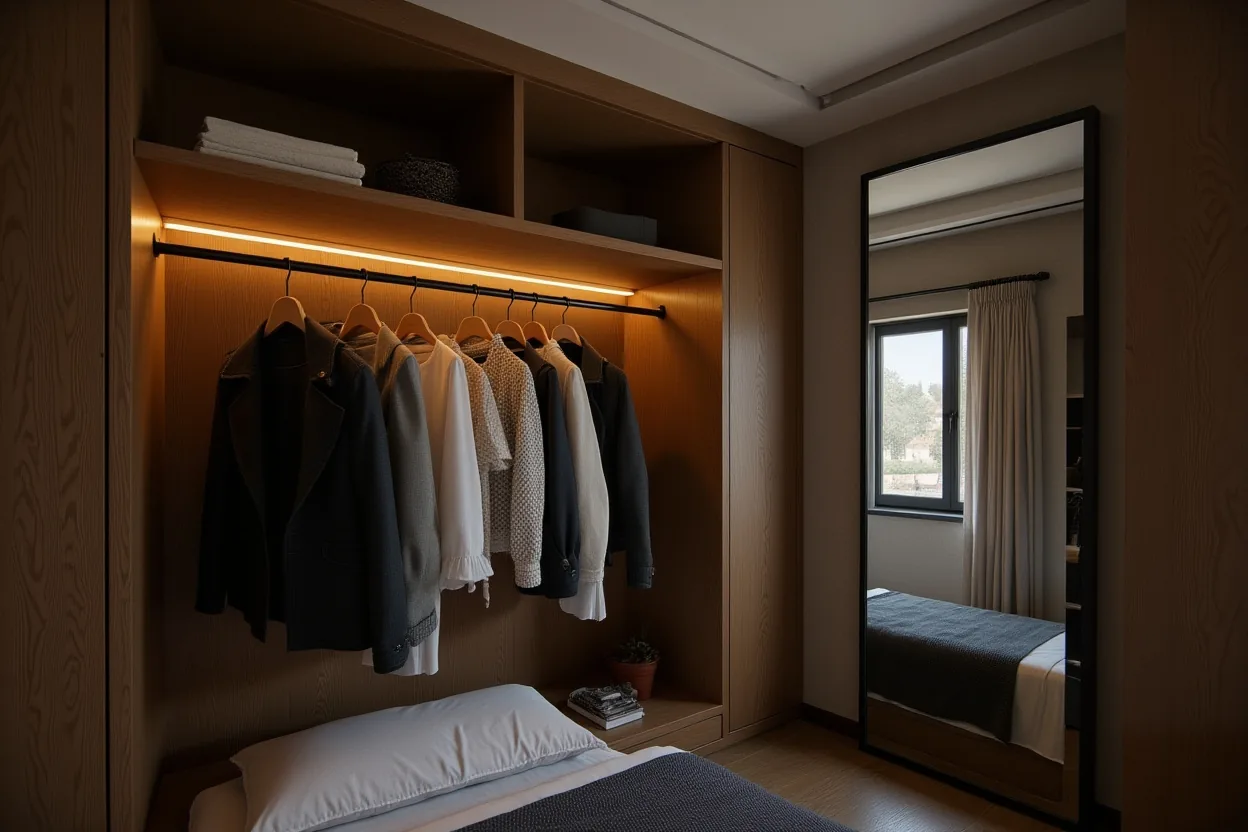
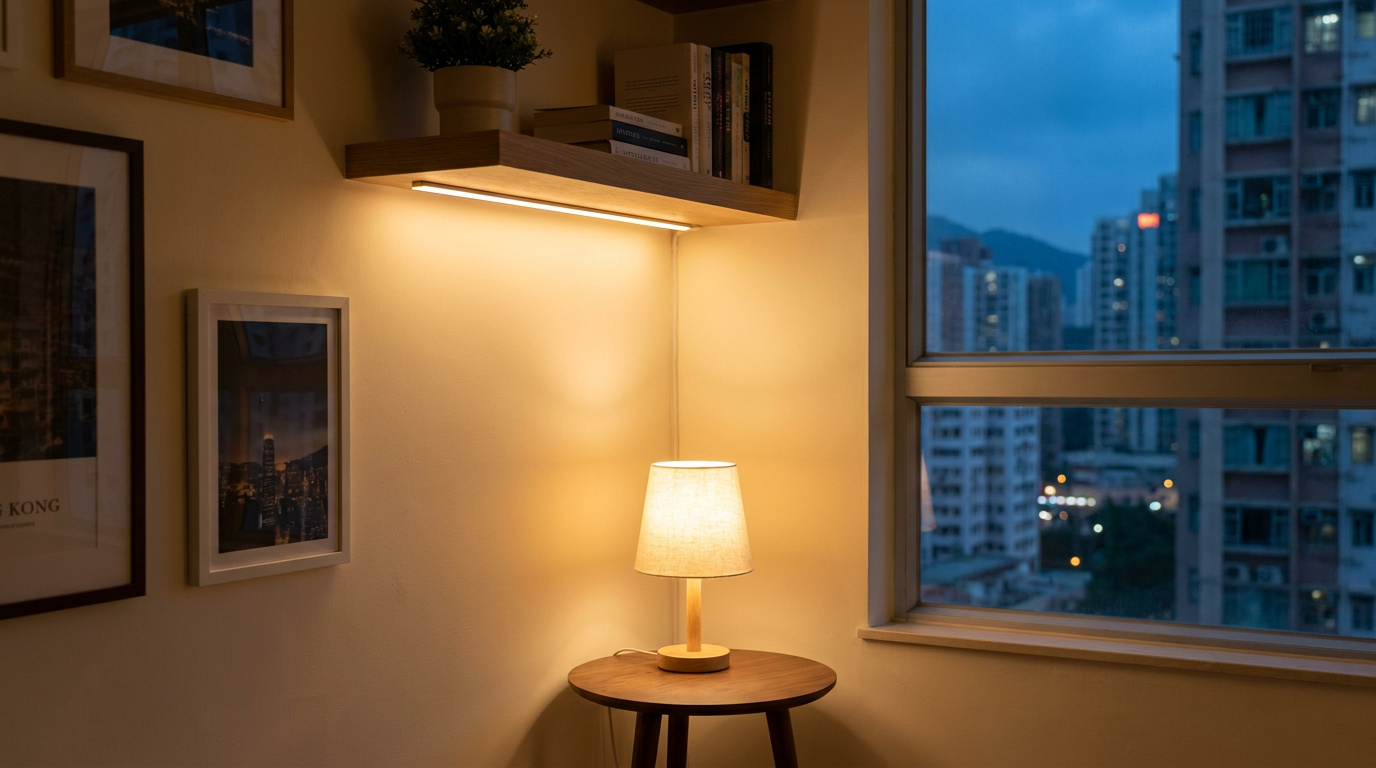
Hong Kong's climate is the biggest enemy of an open dressing area. In the damp spring, humidity runs high and leather and silk are the first to grow mould; a sealed, unventilated closet can actually trap moisture worse. My approach is this: an enclosed dressing room should leave room for damp control, whether a dehumidifier or built-in equipment, with breathing gaps left in the joinery; an open hanging zone has to accept that it will gather dust, so keep valuable or off-season pieces behind closed doors. Lighting matters just as much: a colour temperature that is too cool or too warm makes the colour you see at home differ from the colour outside in daylight. I usually suggest an LED strip close to natural light above the hanging rail, plus fill light at the mirror, so the colour you pick your outfit by is the true one.
An Artwill example: how we planned and delivered it in a real flat
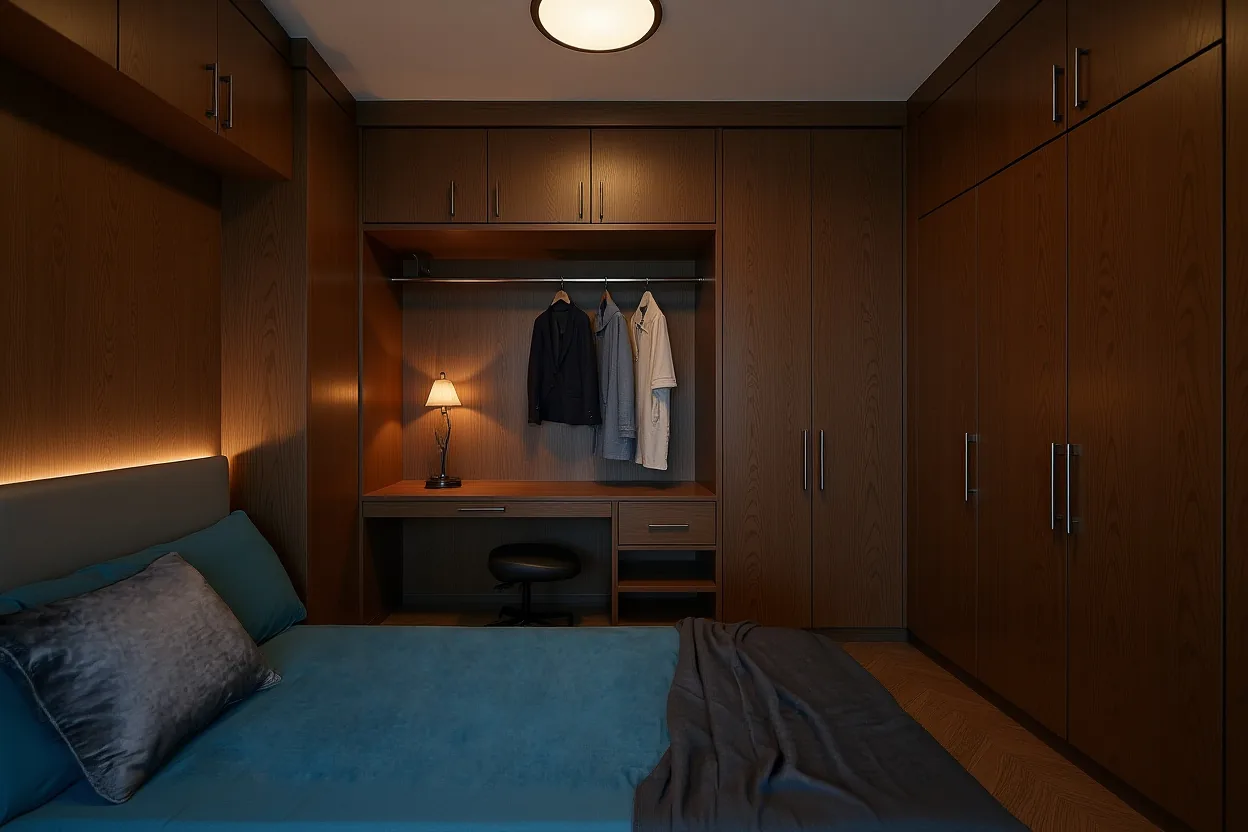
In one of our bedroom projects, the client assumed the room could not hold any dressing space at all. Rather than force in a dressing room, we ran a floor-to-ceiling fitted wardrobe along one whole wall, left an open hanging-and-shelving section in the middle, set a desk beside it, and kept the aisle just wide enough to turn comfortably. It is not the aspirational luxury dressing room you see in magazines, but it is the most sensible answer for this flat: enough storage, clean circulation, every square foot earning its place. Artwill has been designing interiors in Hong Kong since 2004, and the custom joinery is made by the factory we have partnered with for years. We will not rush to sell you a dressing room; we measure first, analyse, then tell you honestly how far your flat can realistically go. If you would like to know whether yours qualifies, book a free consultation and let me come and see the actual space.
Open WeChat, Discover, Scan
Or save the QR and import it from your gallery.