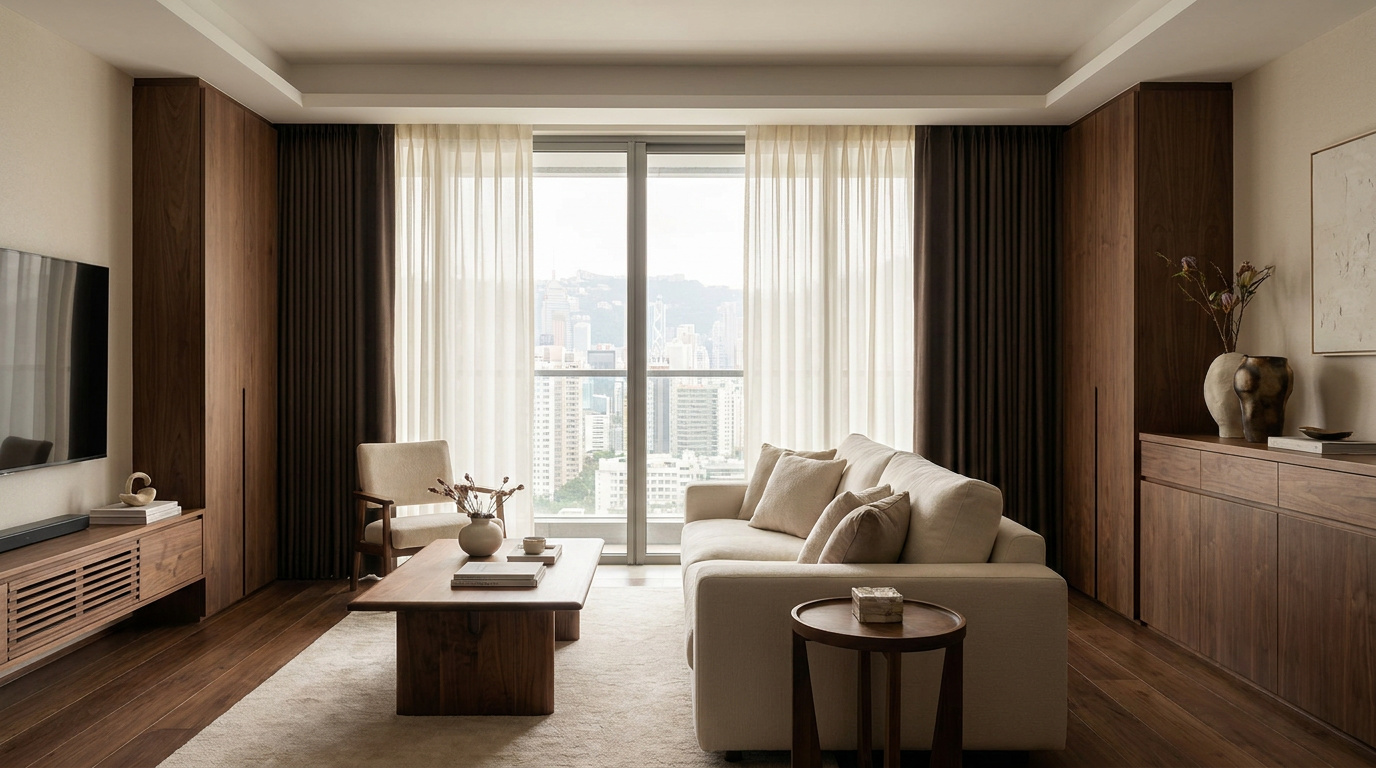
Whether motorised and smart curtains end up looking clean usually has less to do with the product than with the conditions set aside during the renovation. If you choose a wired motor, the wall or ceiling needs a concealed but serviceable power supply, plus a pelmet (curtain box) deep enough to hide the motor head, the track and the gathered fabric; all of this has to be decided before the ceiling is boarded up. By contrast, a tubular motor with a built-in battery, or a curtain robot that clips onto an existing track, needs neither wiring nor changes to the ceiling, which makes both better suited to tenants or a flat that is already occupied. Artwill is the interior design team that plans and coordinates the pelmet, the concealed power, the track and the fabric through the renovation, and briefs the specialist curtain and motor suppliers on what is required; we do not sell, retail or install curtain motors or smart devices.
How motorised and smart curtains differ, and choosing curtain types by room
Motorised curtains are curtains opened and closed by a motor, whether a horizontal traverse motor running along a track or a tubular motor inside a roller blind; smart curtains add a layer on top of that, bringing in an app, voice or scheduled control through a network connection. In other words, a motorised curtain is not necessarily smart, and smart control is an extra layer laid over the top. Motorisation is also one route towards cordless operation, which is a practical safety consideration in homes with young children.
Rather than comparing brands or asking which one is best, a designer usually matches the curtain type to what the room does:
- Fabric curtains (on a track): suited to the soft, full-height cover of a living room or bedroom, often a layer of sheer plus a layer of blackout on a double track.
- Roller blinds: the modern all-rounder, available from light-filtering and sun-screening through to light-softening and full blackout.
- Venetian blinds (aluminium slats): the slats tilt to steer daylight where you want it and cut glare, which suits a study, kitchen or home office.
- Honeycomb (cellular) blinds: the sealed air pockets in the fabric trap air and improve insulation, which suits bedrooms and sun-facing rooms, and a top-down bottom-up version balances privacy with daylight.
- Zebra (day-and-night) blinds: sheer and opaque horizontal bands slide across one another, making it easy to adjust between daylight and privacy.
- Roman blinds: clean folds and a tailored cut, leaning towards texture and shape.
Where a bedroom needs to go fully dark, a blackout roller blind, a blackout Roman blind or a honeycomb blind are all common choices; for a bathroom, a moisture-resistant roller blind is the safer bet. Brands are only examples of a category; what matters throughout is what this particular room needs.
Getting ready before a Hong Kong renovation: the pelmet, concealed power and recessed ceiling track
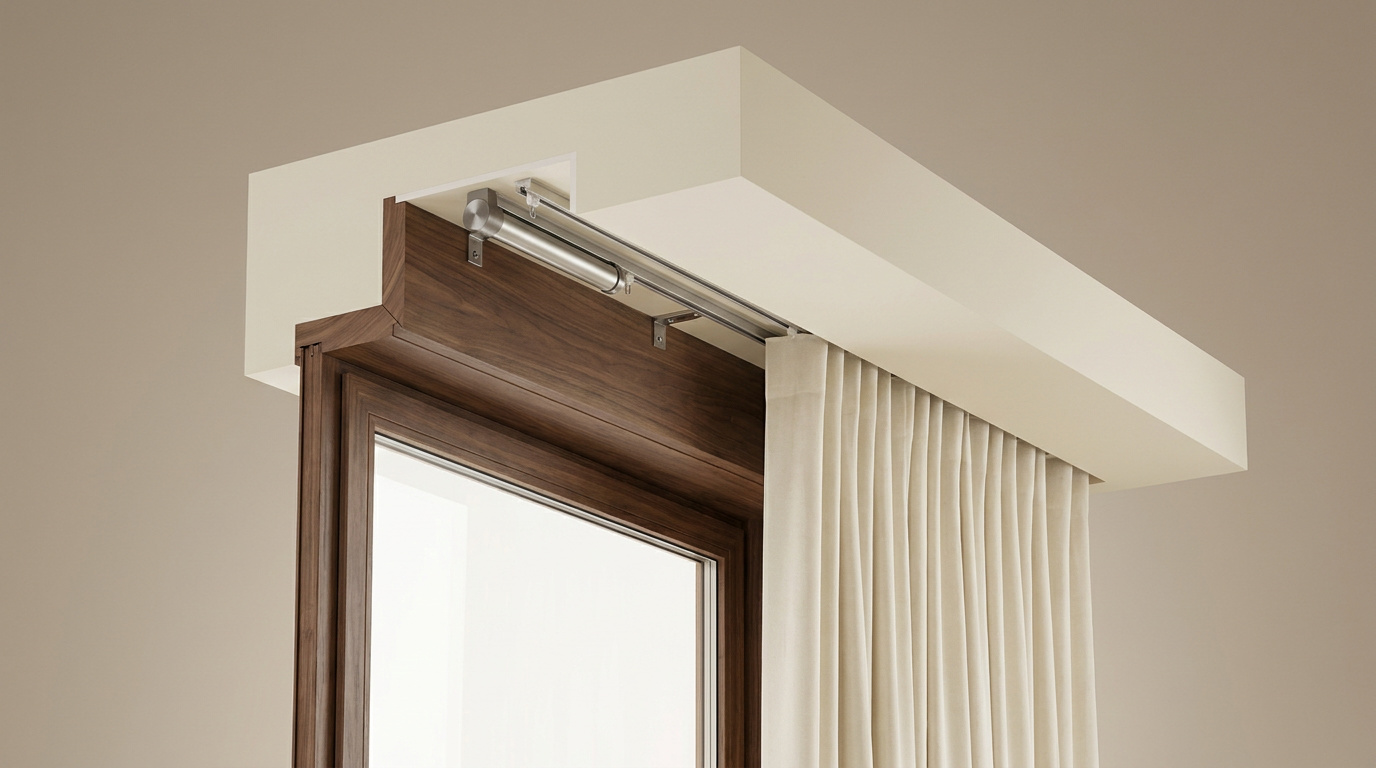
Many Hong Kong flats have no pelmet to begin with, so the designer will build or deepen a pelmet (curtain box) during the renovation to hide the motor head, the track and the gathered fabric together, not merely to screen the fabric. There are two common approaches: the recessed one leaves a channel in the false ceiling so the track sits inside the ceiling, while the semi-recessed one works with a boxed-in beam, tucking the wiring and track together into a dropped false beam. As for the track, a concealed track is one set inside the box or the ceiling channel, whereas where there is no pelmet and the ceiling height allows it, an exposed decorative surface track is the top-fixed alternative. In every case the aim is a clean top line with no hardware in sight.
As for how deep the pelmet should be, rather than memorising a fixed figure it helps to grasp the clearance logic: the depth has to take the track, the wave-folded fabric once gathered and the motor head, plus a little safety margin. The reference figures passed around the trade (not a published Hong Kong standard) run to roughly eighteen centimetres for a single motorised layer, and about twenty-five to thirty-five centimetres for a double layer of sheer plus blackout, while the mechanism alone only needs around ten to twelve centimetres, which is not enough to form a box; a curved or bay-window track needs a little more depth again. The pelmet and track should also extend beyond the window opening on each side (a commonly quoted figure is about fifteen to twenty centimetres) so that drawing the curtains blocks side light; measure to the width of the box, not the width of the glass.
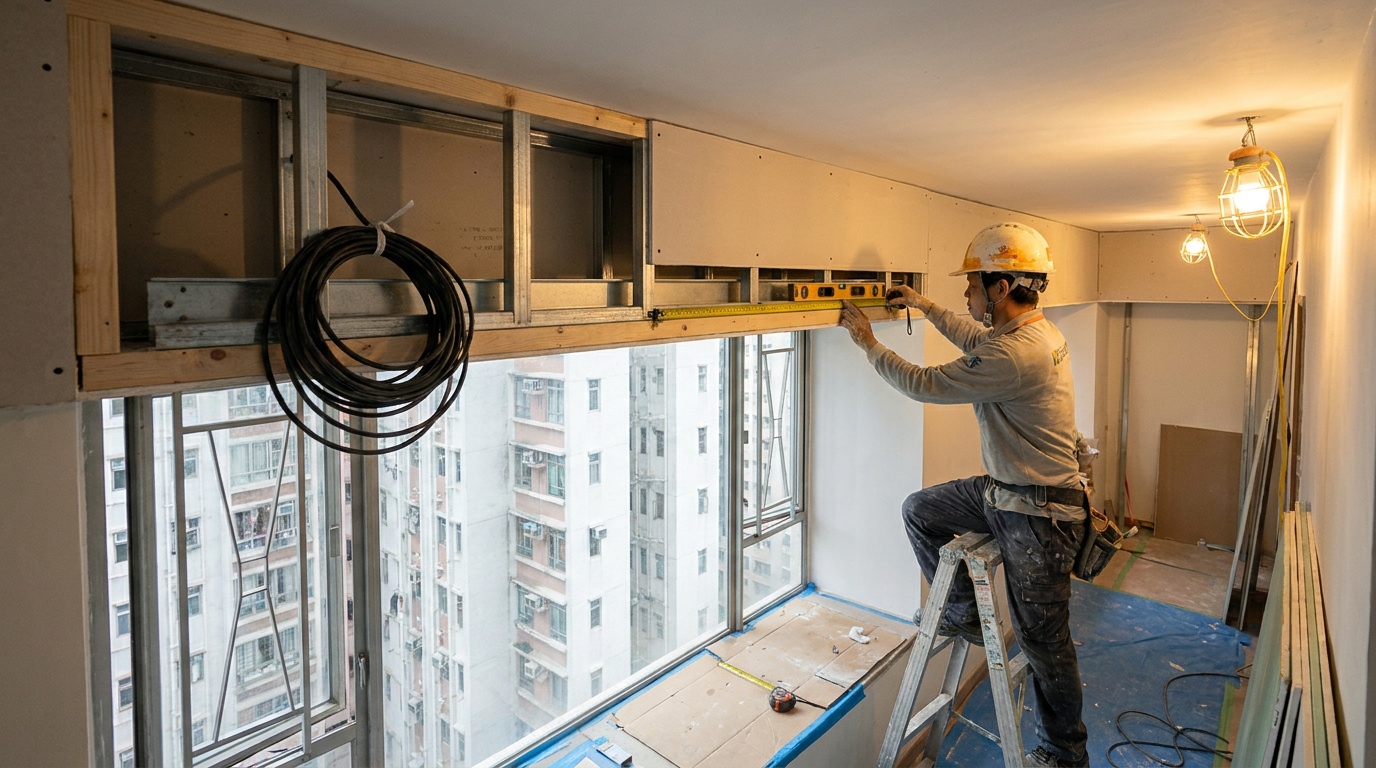
If you go with a wired motor, this step belongs to the first stage (before boarding up), and like the power points and the wiring for smart light switches, it needs to be flagged to the electrician early. A safe approach commonly seen in Hong Kong is to leave the power as a cable (rather than an exposed socket), tucked into the innermost corner of the pelmet and on the correct side for the motor, to be drawn out later and joined to the motor with a quick connector, entirely out of sight. Which side the motor sits on, left or right, has to be settled first, because the cable is led out at the motor end; cable length is a real constraint too, since some local kits come with only about two metres of lead, and if the power is left too far from the motor it may not reach. Just as important is serviceability: leave a route that lets you isolate the power, unplug and inspect, one that cannot be sealed off by fixed joinery. If this supply is not set aside before the ceiling and box are closed up, the wired option is essentially given up, and you are left to fall back on a battery solution.
Wired, battery or curtain robot: which needs a renovation, and which a tenant can manage
The three ways of driving a curtain map directly onto the question of whether a renovation is needed.
- Wired motors (mains AC, or low-voltage DC stepped down through a transformer): the steadiest supply, best suited to heavier or wider drapes, but they need the concealed power and pelmet described in the previous section, so this is a decision that can only be made during a renovation.
- Battery or rechargeable tubular motors: no first-stage electrical work, which suits tenants and flats already occupied; the trade-off is recharging periodically over USB-C (depending on the product, usually every few months) and making sure you can actually reach the motor or its charging lead.
- Clip-on curtain robots: a genuinely renovation-free add-on, driving the existing curtains on an existing track directly.
The curtain robot deserves an honest account of its limits: it only fits certain rod or track profiles (a round rod, an I-track, a U-track) and has size requirements; each unit usually drives a single panel, so a curtain that parts in the middle needs two; it has a weight ceiling; on its own it is mostly Bluetooth, so scheduling, voice and remote access require the brand's hub; it makes a running sound in normal mode; and it needs the existing track and fabric to run smoothly in the first place. Putting a heavy blackout drape on a slightly tight track is therefore a poor match. A more sensible way to place it is as a convenient upgrade where the fabric is light and the track is compatible, not a full-blackout solution for every window.
How to choose: fabric weight against the motor, track width and shape, room use and child safety
The principle for choosing a motor can be understood without exact numbers: the heavier the fabric, the wider or taller the curtain, and the larger the tube diameter, the more torque is needed. Blackout fabric is far denser than sheer, and large picture windows, bay windows and corner windows, along with heavy drapes, all sit at the more demanding end. The trade consensus is clear: failures mostly cluster where the motor has been chosen too close to its lower limit, so you should leave a torque margin, while the exact torque (Nm) and load (kg) figures belong to the supplier's specification and should not be lifted as general fact. A motor chosen too small will stall, labour, overheat and fail early.
The width and shape of the track have real limits too. The local rule of thumb is that a standard motor can comfortably drive up to around two and a half metres (treat this as a reference, not a hard figure), and anything wider calls for a heavy-duty motor, reinforced fixing and mid-span support; a track is best kept within about six metres, since going longer also forces a lighter fabric, or you invite noise, judder and jamming. Bay windows, corners and arches (L-shaped, U-shaped or curved) cannot use a ready-made straight track, and the supplier's fitter has to come to measure on site and make a bent track to order.
What the room is for also shapes the choice: a bedroom is better with a quiet specification paired with blackout, while a sun-facing room suits the insulation of a honeycomb blind. There is also a coordination step that is often overlooked: before the track is fixed, it should be squared off against the window-type air conditioner, the direction the window sashes open, and any removable insect screen, or you only discover after fitting that they foul one another and have to take it down and start again.
Last is cordless child safety. Corded curtains are a documented strangulation hazard, and cordless or motorised operation removes that fatal loop. Home-accident advice from the Hong Kong Fire Services Department also suggests shortening cords and keeping them away from children. It is worth noting that international standards in the United States and Canada, and in Europe, restrict accessible cords and push toward cordless operation, rather than Hong Kong law imposing it; in Hong Kong it is currently a safety recommendation, not a legal requirement.
Connectivity and scenes: Bluetooth, Wi-Fi, Zigbee, Thread, Matter and HomeKit
How a curtain connects decides whether you need an extra hub or bridge:
- Bluetooth: short range and local control, fine for opening and closing on the spot, but scheduling, voice and remote access need a hub.
- Wi-Fi: connects straight to the router, and since many products support only 2.4GHz, it is convenient but adds standby power draw and load on the router.
- Zigbee / Thread: low-power mesh protocols that need a coordinator or hub, with Thread requiring a border router.
- Matter: a cross-ecosystem standard, so a Matter-capable motor can join Apple Home, Google Home, Alexa and SmartThings at once, provided the home already has a Matter controller.
- HomeKit: controlling it away from home needs a home hub, such as a HomePod or an Apple TV.
So before specifying a motor, confirm the client's smart-home ecosystem, to avoid buying a bridge after the fact; at the same time keep an RF physical wall switch as an offline fallback, so the curtains still work if the network goes down. If you want to fold the curtains into fuller automation, see our piece on smart home design and hubs in Hong Kong. Useful scenes include a gentle opening at dawn as a wake-up cue, an automatic close or tilt against the afternoon sun to block glare, a privacy close at dusk, and an away-from-home opening and closing that mimics someone being in; these scenes can also work in step with the lighting, the air conditioning and the sensors. If the curtains are set to open on a morning schedule, the designer should flag that the motor sound will be heard in the bedroom at that hour.
Connected devices also raise security considerations. The Consumer Council's general guidance on networked smart homes points out that because Internet-of-Things devices share one network, a single compromised device can drag in the others; it advises setting a different password on each device, tightening the privacy and security settings, keeping firmware updated, turning off features you do not need, and watching for unfamiliar connections. The Council also notes that some smart products may not suit Hong Kong's voltage or specifications. To be clear, there is at present no Hong Kong Consumer Council test or ranking specifically for motorised or smart curtains, and it would be wrong to assume such a report exists.
When to decide, and the designer's role
The decisions that have to be locked in during a renovation, set out in order:
- Before boarding up, decide first between wired, battery or robot, because only the wired option needs work done now.
- If you go wired, run the concealed supply on the correct side for the motor and cap the end ready to connect.
- Build the pelmet to a sufficient depth for the chosen track and the gathered fabric, and extend it beyond the window opening on each side.
- Settle the track shape, and for a bay window or any non-rectangular window book the supplier to measure on site.
- Then match the fabric weight to the motor torque with a margin, keep a quiet specification for the bedroom, and confirm the smart-home route (most motors use 2.4GHz Wi-Fi, and remote control needs a hub).
The point to stress is that wired is a first-stage decision, and missing the boarding-up is to lose it; most later regret comes from gaps in the planning (no power set aside, a box too shallow, a motor too small, an ecosystem that does not connect), not from the product itself. Artwill's position is clear: through the whole renovation we plan, sequence and conceal the pelmet, the power, the track and the fabric, and brief the specialist curtain and motor suppliers on what is required; we do not sell, retail or install motors or smart devices. Curtain planning is only one part of residential interior design as a whole.
A word in passing on the Deed of Mutual Covenant (DMC): interior curtains are generally a matter within the flat, and changing curtains does not usually breach the DMC; only when the treatment is visible from outside or fixed to the external wall (an external awning, say, or anything that alters the appearance) might the relevant DMC clauses apply. This is best kept in proportion and not over-read.
Open WeChat, Discover, Scan
Or save the QR and import it from your gallery.