
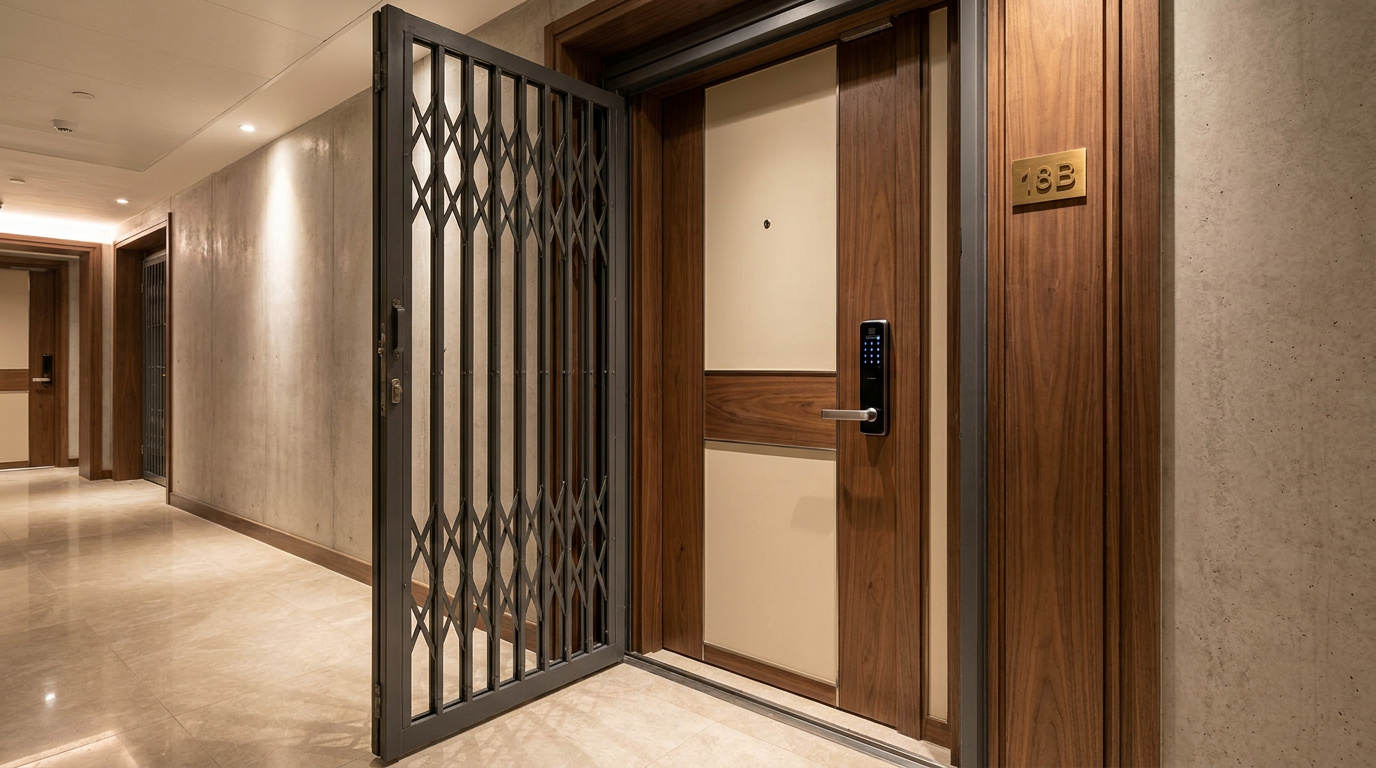
Electronic door locks run on batteries, so a renovation does not require fresh wiring; that is the convenient side of them. But in Hong Kong the real difficulty is not the lock itself, it is the door and metal gate it has to work with, and the rules surrounding fire doors and escape. Whether the entrance door is a fire door, the fact that a metal gate lock and a timber door lock are not interchangeable, the need to open from inside during escape, and automatic release on power failure: all of these have to be arranged together at the renovation stage. Artwill is the interior design and build team that plans all of this. During a renovation we coordinate the door, gate and lock pairing for residents, and liaise with locksmiths and suppliers. We are not a retailer or installer of door locks.
What electronic and smart door locks are: unlocking methods, main locks and auxiliary locks
An electronic door lock verifies identity electronically and then drives the bolt, so residents no longer rely on a traditional key; a smart door lock adds connectivity on top of that, so it can work with a mobile app or a smart-home system. The line between the two is not strict, and many models on the market combine both. When choosing, what really needs to be clarified is which door it has to work with, and how each member of the household is used to coming and going.
Common unlocking methods each have their trade-offs:
- Fingerprint: the most convenient day to day, but reading can fail more easily for older people with worn prints, or when a finger is damp.
- PIN code: usually four to six digits, and with random or virtual prefix and suffix entry you can stop onlookers seeing the real code.
- Proximity card: suitable for children and older people; if a card is lost you can delete its authorisation directly on the lock, without changing the whole lock.
- Mobile app: mostly paired over Bluetooth, with some models supporting Wi-Fi or NFC.
- Facial recognition: contactless, and especially convenient when your hands are full.
- Physical key: almost every model keeps a key cylinder, so the door still opens at zero battery.
Another thing to decide first is whether to use a main lock or an auxiliary lock. A main lock has handles on both sides and suits replacing the whole door or fitting a new one; an auxiliary lock has no handle and is added on top of the existing lock. Which one suits depends on the door leaf, the frame and the existing hardware, and this is exactly what needs to be coordinated with the door maker and locksmith at the renovation stage. As an interior design and build team, Artwill plans and coordinates the door, gate and lock pairing for residents during a renovation, and does not retail or install smart door locks or any other smart device.
The reality of a Hong Kong doorway: metal gate, timber door, and whether it is a fire door
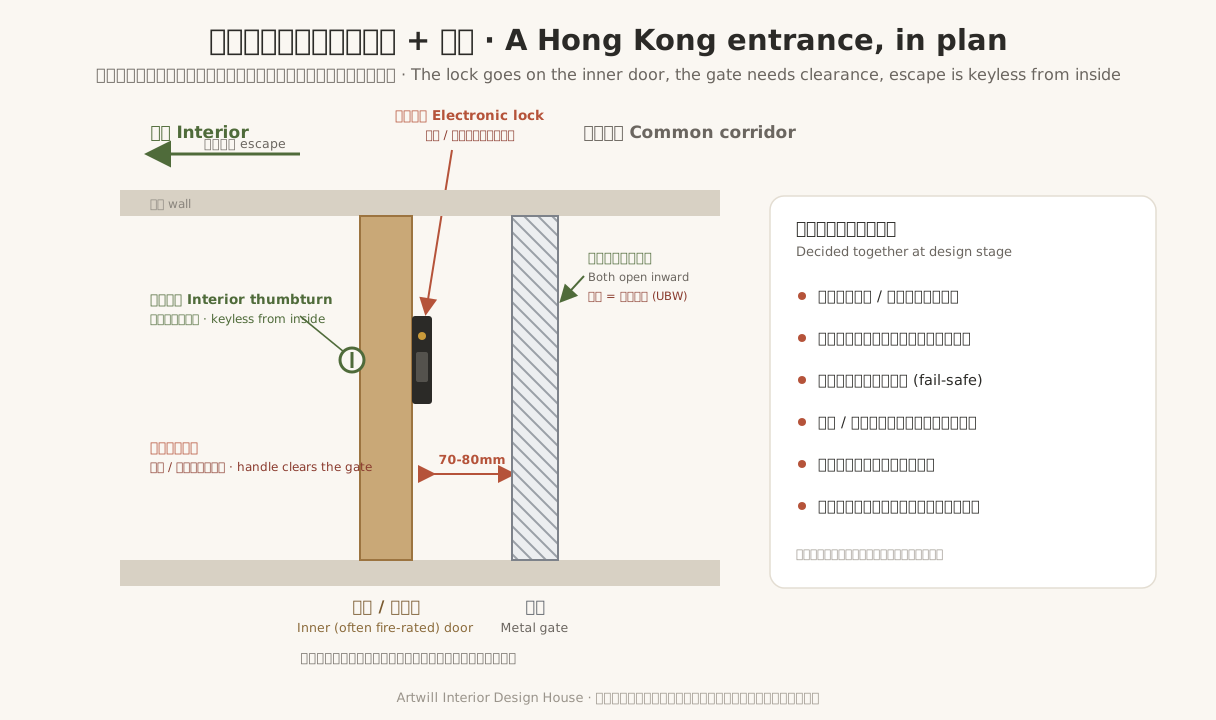
A Hong Kong flat entrance is usually a metal gate on the outside plus a door on the inside. It is the inner leaf that carries the fire-resisting and self-closing functions; the metal gate is only a security barrier, not a fire element. Electronic door locks therefore fall into two categories, the metal-gate-frame type and the solid-leaf type, and the two are not interchangeable.
Because the gate and the door sit very close together, a few points need to be considered together before choosing:
- Between the door leaf and the metal gate, common installation guidance suggests leaving roughly 70 to 80 mm, so that a protruding handle or a door viewer clears the metal gate.
- Door-leaf thickness is commonly around 45 to 60 mm (timber doors are generally over 40 mm), the cylinder offset is usually within about 70 mm, and the internal lock-body depth is around 12 cm. These are the planning ranges from supplier data, not statutory dimensions, and the actual leaf and the chosen model should be the reference.
- Iron doors, aluminium doors, sliding doors and glass doors generally cannot take a standard electronic door lock; a plain timber door that has not been drilled needs the carpenter to cut the lock hole first.
- The steel gates of public rental housing and Home Ownership Scheme flats have a tube frame and lock-body space that differ from a typical mainland security door, so most standard mainland smart locks do not fit; you need a model clearly marked as suitable for steel-gate installation, handled by a fitter with local adaptation experience, otherwise the bolt jams easily and the metal gate cannot close.
Then there is the fire-door question. Not every residential entrance door is a fire door: whether the leaf needs to be fire-resisting depends on how it connects to the means of escape (for example opening onto an enclosed common corridor, a smoke lobby, or a position next to a required staircase). Buildings Department guidance mentions the practice of a one-hour separation between the entrance door and the common area, but the exact fire-resistance period varies with the building and its year of completion. The safe approach is to treat the existing leaf as a fire door first, then confirm from the approved plans or building records, rather than applying a fixed number.
For a fire-rated entrance door, the Buildings Department generally requires: a solid timber door (or the construction set out in its test report), fitting closely against the surrounding wall without an obvious gap, fitted with a self-closing device (a door closer), and accompanied by a supplier's declaration and a test or assessment report from an accredited laboratory; a self-closing fire door should not be held open unless an approved device is used. It is worth noting that the fire certification applies to the door assembly as a whole, so drilling, slotting or over-cutting the leaf removes the door core and the fire-expanding material, changing the assembly that was tested and possibly voiding the certification. So before fitting an electronic door lock on a fire door, it is best to reuse the existing lock hole and offset as far as possible, keep the door closer and the seals, and choose a lock with fire-test evidence for that door type, while first confirming with the door maker or a qualified locksmith.
The relevant regulatory documents include the Buildings Ordinance, together with the Buildings Department's Code of Practice for Fire Safety in Buildings 2011 (2024 edition) and the 1996 Code of Practice for Fire Resisting Construction; for older buildings, the Fire Safety (Buildings) Ordinance (Cap. 572) also applies, which came into effect on 1 July 2007 and targets composite and domestic buildings whose plans were submitted to the Building Authority on or before 1 March 1987. Any specific clause number should be taken from the original text of the code.
Safety, power failure and escape: what the regulations and the Consumer Council actually say
On escape, a few points cannot be compromised. The Buildings Department stipulates that a lock on an exit door must be openable from the inside at any time, without a key; and if it is an electrically operated lock, it must release automatically on power failure. Translated into design language: the inside of an escape door should have a thumbturn or single-action opening, avoiding a double-cylinder deadlock that needs a key on both sides; any electric lock should be required to fail safe (fail open) on power loss, and keep a mechanical key as backup, or an emergency power contact.
As for power failure or a flat battery, door locks now generally have an emergency power contact on the outdoor panel, so a drained internal battery can be temporarily powered to open the door once; older models and Consumer Council material mention a 9V terminal, while many newer models have switched to a USB-C port, so it varies by model and should not be generalised. Another backup is the physical key cylinder that almost everyone has, still usable at zero battery; but residents often leave the key at home, so it should be entrusted to someone trustworthy, or kept away from the flat.
On buying, many people ask about Consumer Council testing. What Hong Kong's Consumer Council has done on electronic door locks is a market survey (CHOICE Magazine issue 464, June 2015, covering 19 electronic door locks: 15 main locks and 4 auxiliary locks), a record of complaint cases (issue 531, January 2021) and buying tips. It is not a graded laboratory safety test, and it did not publish scores for lock-picking, bolt strength or fingerprint speed. The body that did carry out graded testing of lock-picking, pry resistance, bolt strength and fingerprint speed is the Shenzhen Consumer Council (December 2024), conducted under the mainland standard GA 374-2019 for electronic anti-theft locks; that standard is a mainland product standard, not Hong Kong law, and should be treated as a mainland reference only.
One more point relates to later servicing: many brands' warranties are conditional on installation by their authorised installer. Artwill does not retail or install door locks, so at the planning stage we remind residents to note the supply and installation channel, and to factor the warranty conditions into the decision.
The practical drawbacks a designer handles in advance
An electronic door lock is not unusable; rather, there are practical drawbacks that need to be arranged for at the design stage and resolved one by one:
- Being locked out: a flat or faulty battery leaves you unable to get in. If the leaf itself self-closes, together with an auto-lock mode, then going out without a key means the door closes and bolts by itself; the buffer time on a low-battery warning is also limited, so you need to leave room in the settings and in habit.
- Environmental effects: Hong Kong's humidity and heat, more pronounced during the damp "return of spring" season, increase fingerprint misreads; the worn prints of older people and the shallow prints of young children also often fail. It is best to also enable a PIN or proximity card; if the household has such users, palm-vein or 3D facial recognition is a contactless alternative.
- Power and battery: a leaking battery can damage internal parts, and there has been a case where a factory default of staying permanently on drained the battery, leaked and burned out the circuit board.
- Noise and finger-pinch: an automatic bolt makes a noticeable sound as it shoots out (sometimes a frame buffer strip is added); an electric handle without a genuine anti-pinch design may pinch fingers, so a door used by children is best fitted with an anti-pinch model.
- After-sales and warranty: there have been complaints involving a PIN failing within a few days, a battery leaking and causing damage after about seven months, and an alarm triggering an auto-lock that trapped residents indoors; a warranty also does not always mean free repair.
- Parallel imports and privacy: a parallel-import unit lacks a local after-sales channel and fails more easily in a humid environment, and a lithium battery on a sun-facing door carries a heat risk; if the lock has a built-in camera, treat that as a privacy decision. Many models store biometric templates in an encrypted partition on the device itself rather than uploading to the cloud, but this is good practice rather than a given, and any cloud-connected feature (remote unlocking, doorbell recording) still involves an account, so it is best to read that model's privacy notes first.
- Door-altering work: mainland door locks often cannot slot straight into an old Hong Kong door. In one local case, a Xiaomi lock body did not line up with the existing lock hole, so a locksmith had to chisel, plane the leaf thinner and grind down an over-long bolt and cylinder tail, a process with noise and sparks that disturbs neighbours. So treat it as work that needs a craftsman's involvement, not a plug-and-play accessory.
How to choose well: a designer's selection criteria, not a brand ranking
Rather than asking which model is best, or what to recommend, it is better to turn the question into a set of criteria, then match them against your own door and household:
- Match the door type and fire rating first: this is the top priority, and it decides the range of locks available.
- Escape, fail-open on power loss and a key backup cannot be compromised: keyless opening from the inside, automatic release of the electric lock on power failure, and a mechanical opening kept.
- Match the unlocking method to household members: three generations under one roof should not rely on fingerprint alone, and should keep a second method such as a PIN or proximity card.
- Choose the connectivity tier by need: Bluetooth only pairs at close range and cannot open the door remotely; for remote control, operating away from home, or joining smart-home automation, you generally need built-in Wi-Fi, a Zigbee gateway, or a Matter over Thread border router in your home ecosystem. Whether you really need remote features is the dividing line at this tier.
- Supply and after-sales channel: prefer genuine stock with local after-sales and authorised installation, rather than the cheapest parallel import.
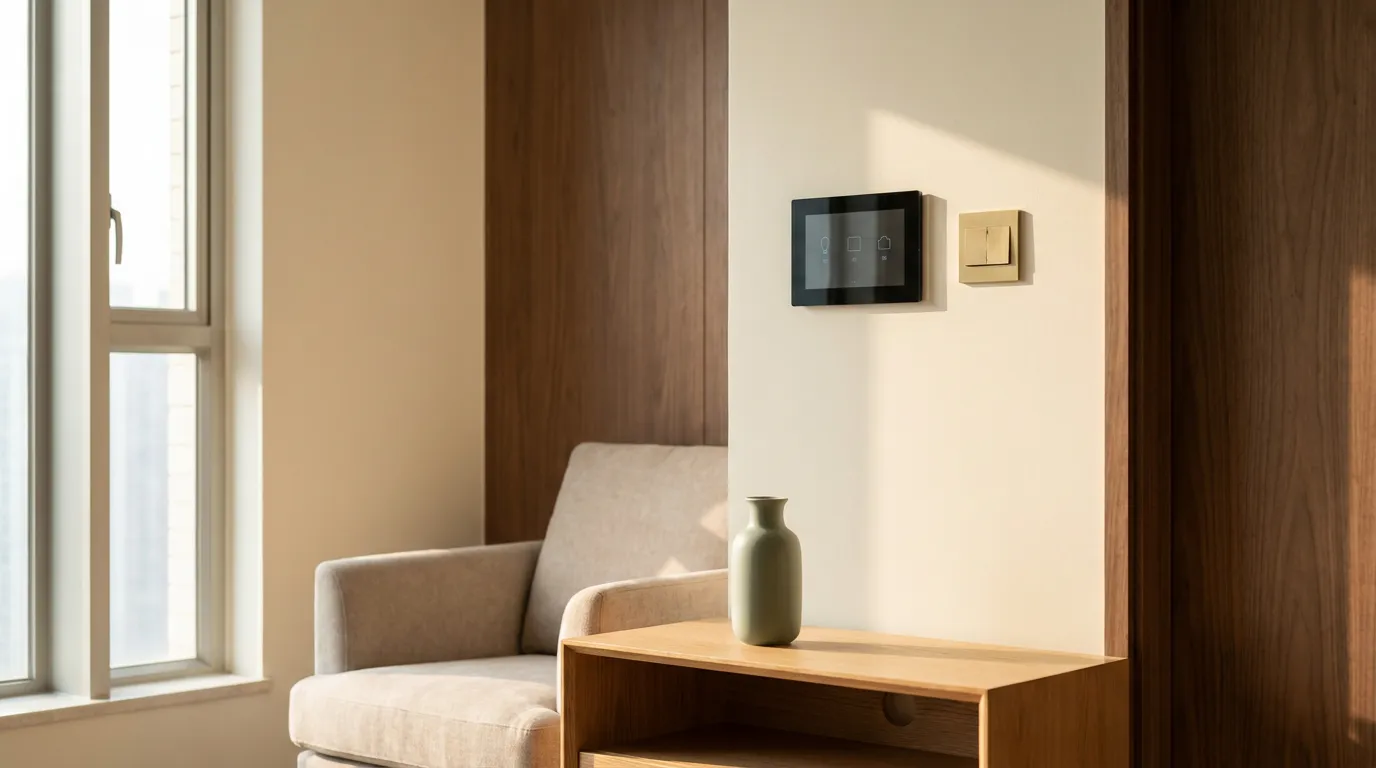
Worth a special mention: an electronic door lock is powered by AA alkaline batteries or a built-in lithium battery, not mains power, so a renovation does not require slotting or laying new wiring. The Consumer Council generally describes battery life as roughly 10 to 12 months in everyday use, with an automatic low-battery warning, though the actual figure varies with frequency of use, unlocking method, and whether Wi-Fi or a camera is on. For this reason, compared with a smart light switch or smart lighting that involves wiring, a door lock is one of the least disruptive smart upgrades in a renovation. To connect the lock into a more complete system, you can also refer to the overall planning in smart home design. As for price, the focus is on the cost factors (a non-standard door needing alteration, the metal gate and leaf using different hardware, professional installation, warranty conditions), not a single figure.
At which step of the renovation to decide, and the designer's role
Whether to keep or remove the metal gate should be decided at the design stage, because it changes the specification of the door, gate and lock at the same time. Handle the three separately, and you often only discover at the end that the hardware clashes.
A sensible order runs roughly as follows:
- Confirm the door leaf's fire rating and type first, and verify from the approved plans.
- Check the building's deed of mutual covenant and the management office's house rules: the door face onto a common corridor, and any part protruding into the common corridor, may touch on common parts under the covenant, and many buildings also regulate the appearance of the entrance door and forbid it from opening outwards.
- For tenants, replacing a door or lock generally needs the landlord's written consent; use a reversible installation method, keep the original cylinder, and restore it on moving out.
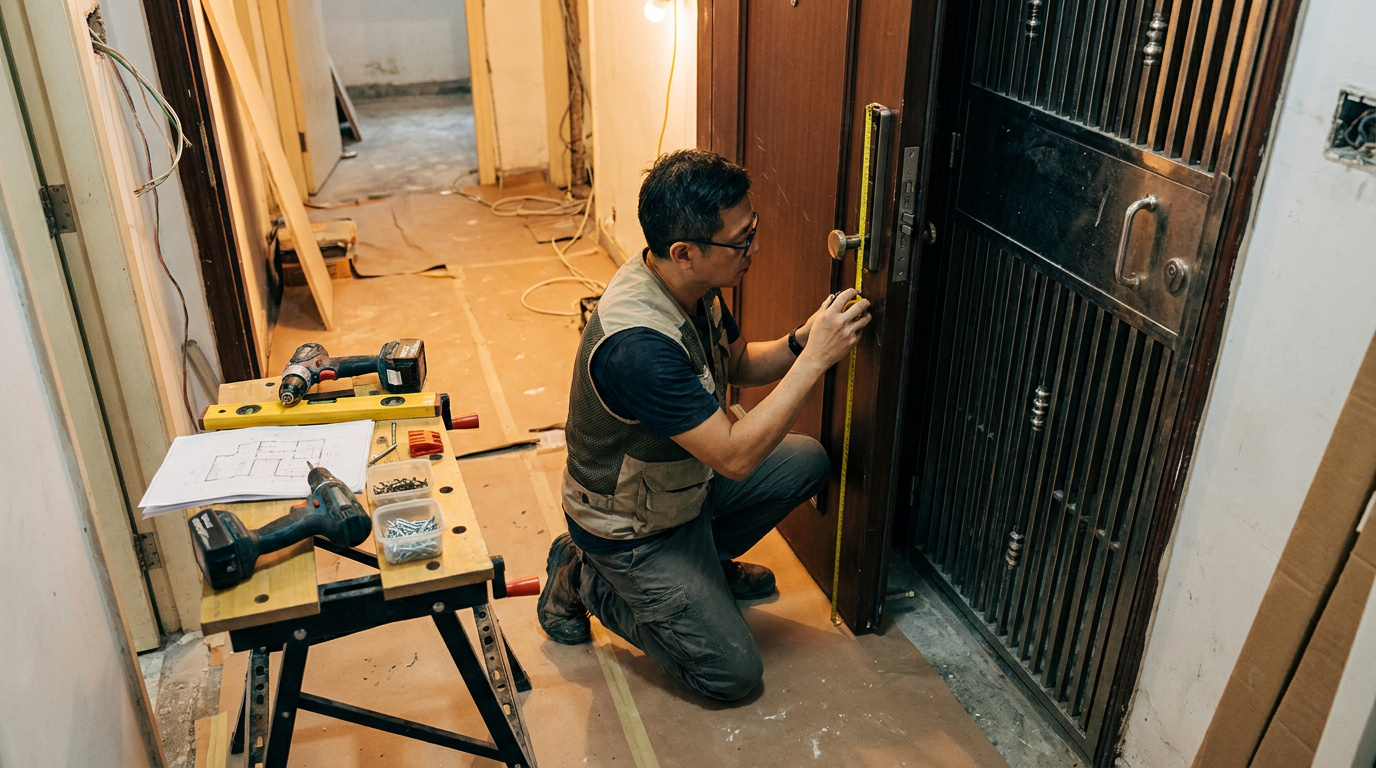
- Measure the actual door before placing the order.
- Altering the metal gate is an item under the Minor Works Control System, and should go through a registered minor works contractor with the required notification, rather than being treated as needing no procedure.
- Both door and gate should open inwards or towards the interior; a gate or door opening outwards onto a common corridor obstructs the means of escape, and the Buildings Department may treat it as an unauthorised building work.
- Coordinate the carpenter, locksmith and supplier, and set out the requirements clearly.
Artwill's position is clear: during the works we plan and coordinate the door, gate and lock, and liaise with the locksmith or supplier, but we do not retail or install smart door locks or any other smart device. Designing the entrance as a whole, considering the metal gate, the leaf, the lock, escape and the corridor-facing appearance together, is exactly what makes this door both usable and compliant in the end. This kind of holistic planning is also part of our residential interior design service.
Open WeChat, Discover, Scan
Or save the QR and import it from your gallery.